By early 2026, Claude had become a go-to tool for AI product teams, founders, and engineering leaders building everything from coding copilots to autonomous agents. The challenge? Claude’s pricing, across Pro, Max, Team, and API tiers, can be hard to untangle when you’re trying to forecast budgets, justify headcount, or understand where costs really add up. With Claude 4.5 models like Opus and Sonnet, alongside Claude 3.5 Haiku, now powering many production AI features, even a 5–10% swing in token costs can have a real impact on margins.
This guide walks through Claude Pro, Max, Team, and API pricing using concrete 2026 numbers, with practical examples for startups and growing teams. We’ll break down usage limits and cost-control strategies like prompt caching and batch processing so you can plan more confidently. And while pricing clarity matters, most teams quickly discover the bigger bottleneck isn’t model spend, it’s finding engineers who know how to use these models efficiently. That’s where Fonzi AI comes in, helping companies hire experienced AI engineers who can make smart architectural and cost decisions and get production-ready fast.
Key Takeaways
Concrete pricing in 2026: Claude Pro costs $20/month (or ~$17/month annually), Claude Max runs $100 and $200/month for 5x and 20x tiers, Team starts around $30/user/month with a 5-seat minimum, and API rates for Opus 4.5 sit at $5/$25 per million tokens while Sonnet 4.5 comes in at $3/$15 per million tokens.
Max tiers differ on capacity, not features: Both Claude Max 5x and 20x include all Pro benefits, the primary difference is message limits and throughput, making them ideal for founders, researchers, and engineers who live in Claude all day.
Smart model selection cuts costs dramatically: Choosing Haiku for simple tasks, Sonnet for most production work, and reserving Opus for complex reasoning can reduce Claude API costs by 30–50% when combined with batch processing and prompt caching.
Hiring is the bigger constraint: Even with clear Claude AI pricing, most companies struggle not with Claude costs but with finding engineers who can architect cost-efficient, high-impact AI workflows, which is exactly what Fonzi AI solves by matching elite AI engineers with startups in under three weeks.
Claude Subscription Plans at a Glance (Free, Pro, Max)
Claude’s consumer and prosumer tiers break down into three main categories in 2026: Free for light chat and exploration, Pro for professional daily use, and Max for heavy power users who need significantly more usage than Pro provides.
All paid tiers include access to the latest Claude models, including Opus 4.5 and Sonnet 4.5 as of 2026. You also get Claude code access, Artifacts for document creation, and higher usage limits than the free tier allows.
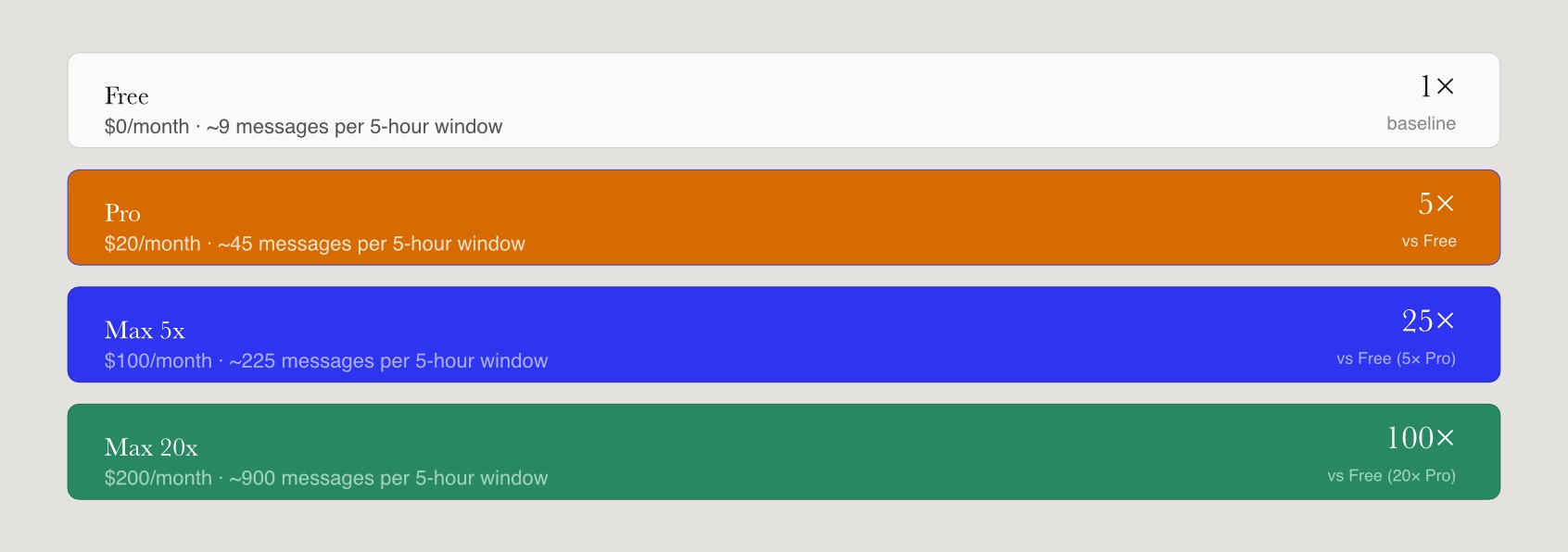
Usage is still soft-capped via message limits per 5-hour window. The free plan allows roughly 9 messages per window, while Pro jumps to approximately 45 messages. Max tiers push this significantly higher. Paying users also receive priority access during peak hours when the system is under load.
These subscription plans work best for individuals, including founders, staff engineers, product leaders, rather than full product stacks, where API and Team plans make more sense for integration and collaboration.
Claude Pro Plan (2026)
Claude Pro in 2026 costs $20/month on monthly billing and approximately $17/month when billed annually. This pricing has remained consistent with prior years, making it a predictable line item for individual professionals.
The key benefits of Pro include:
Roughly 5× the usage of the free tier
Faster responses with priority during peak times
Full access to Opus 4.5, Sonnet 4.5, and advanced Claude AI models
Claude Code for programming assistance
Projects and workspaces for organizing conversations
Early access to new features and capabilities
Pro typically allows around 45 messages per 5-hour window when using Sonnet-level quality, though this adjusts dynamically based on model load. For context, the free tier caps at roughly 9 messages in the same window.
Claude Pro is ideal for technical founders, solo engineers, and AI product managers who work in Claude daily but don’t yet need Max-tier capacity. If you’re validating ideas, drafting code, or using Claude for research and writing, Pro covers most individual workflows comfortably.
For small teams (say, sub-5 people exploring AI ideas before building full products) a handful of Pro seats can be cheaper and simpler than jumping straight into Team or API. You avoid minimum seat requirements and get started immediately.
Claude Max 5x and 20x Plans (New Premium Tiers for 2026)
Claude Max represents Anthropic’s premium tier, launched in 2025 and expanded in April 2026 into two message-multiplier options designed for power users who consistently hit Pro’s limits.
Pricing breakdown:
Max 5x: $100/month per user, offering roughly 5× Pro’s usage limits (about 25× Free)
Max 20x: $200/month per user, offering roughly 20× Pro’s usage limits (about 100× Free)
Both Max tiers include everything in Pro, including priority access, Claude Code, access to the latest models, but differ primarily in capacity. The more usage you need for high-intensity conversations, large file analysis, and extended sessions, the higher you should go.
Typical Max users include:
AI researchers running long experiments and iterating on prompts
Engineers building agents and spending 6–8 hours daily in Claude
Quant teams and analysts processing large datasets
Founders who rely on Claude for planning, coding, and strategic analysis
How to choose between 5x and 20x: If you regularly hit Pro limits or rely on Claude for heavy use throughout the workday, Max 5x is a reasonable starting point. If you’re a “live in Claude” power user, running live demos constantly, or processing large documents repeatedly, Max 20x justifies the additional spend.
At $200/month, Max 20x positions directly against ChatGPT Pro at the same price point, but Claude excels in document analysis, coding tasks, and fewer safety-triggered refusals on complex prompts compared to some competitors.
Claude Team and Enterprise Plans (Per-Seat Pricing)
Claude Team and Enterprise plans provide organizations with centralized billing, admin controls, security features, and shared workspaces. If you’re managing more than a handful of Claude users, these plans make more sense than coordinating individual Pro or Max seats.
As of 2026, Claude Team pricing typically starts around $30/user/month on monthly billing. Annual commitments often bring discounts, and workspaces require a minimum of about 5 seats to get started.
Higher team tiers can approach $100–$150/user/month for organizations needing more generous built-in usage, advanced compliance, and priority rate limits. Enterprise plans are custom-quoted based on specific requirements.
Key Team and Enterprise features include:
SSO integration (SAML/SCIM) for secure authentication
Central billing and seat management
Usage dashboards and cost reporting
Shared prompts, projects, and unlimited projects for collaboration
Enhanced security settings for regulated industries
Dedicated support for Enterprise customers
Fast-scaling AI startups often combine a small Claude Team deployment for collaboration and exploration with direct Claude API usage for production integrations. This hybrid approach gives you the best of both: structured team access for internal work and granular api access for shipping features.
Claude API Pricing in 2026: Opus 4.5, Sonnet 4.5, and Haiku
The Claude API operates on a pay-as-you-go model where you pay per million tokens of input and output tokens. This is the primary choice for building AI products, agents, and internal tools where you need programmatic access rather than a chat interface.
2026 api pricing is model-specific, with three main families serving different use cases:
Model | Input Cost (per million tokens) | Output Cost (per million tokens) | Best For |
Claude Haiku 4.5 | ~$1 | ~$5 | Speed-optimized, high-volume tasks |
Sonnet 4.5 | ~$3 | ~$15 | Balanced intelligence for agents and code |
Opus 4.5 | ~$5 | ~$25 | Most capable complex reasoning |
These rates represent significant cost reductions, up to 67% from prior generations like Opus 4.1, which ran $15/$75 per million tokens. This shift makes many production applications economically viable that weren’t before.
Important pricing notes:
Long-context Sonnet 4.5 calls exceeding 200K input tokens are billed at roughly double the standard rates
Batch processing discounts token costs by approximately 50% for asynchronous workloads
Prompt caching can bring repeated prompt costs down to roughly 10% of base input rates
For Claude 3.5 Sonnet and Claude Sonnet workloads, the current pricing makes it possible to run substantial production applications without burning through budget, especially when you leverage prompt caching and batch processing for predictable workloads.
Claude Pro vs Max vs Team vs API: Comparison Table
When planning budgets, a side-by-side view of Pro, Max, Team, and direct API pricing makes the tradeoffs immediately clear. Here’s how the options stack up in 2026:
Plan | Target User | Pricing | Usage Included | Key Features | Best For |
Free | Casual users | $0/month | ~9 messages/5 hours | Basic access, web search, Artifacts | Testing and light exploration |
Pro | Individual professionals | $20/month ($17 annual) | ~45 messages/5 hours (5× Free) | Priority access, Claude Code, Projects, early feature access | Founders, solo engineers, daily Claude users |
Max 5x | Heavy individual users | $100/month | ~225 messages/5 hours (5× Pro) | All Pro features + enhanced capacity | Researchers, engineers hitting Pro limits |
Max 20x | Power users | $200/month | ~900 messages/5 hours (20× Pro) | All Pro features + maximum capacity + exclusive tools | "Live in Claude" users, heavy daily workloads |
Team | Organizations (5+ seats) | ~$30/user/month | Higher usage limits, shared across team | SSO, central billing, admin tools, shared projects | Startups and enterprises needing collaboration |
Enterprise | Large organizations | Custom pricing | Maximum usage, custom terms | Compliance API, dedicated support, custom integrations | Enterprise customers with intensive AI needs |
API (Sonnet 4.5) | Developers, production apps | $3/$15 per million tokens | Pay-as-you-go | Programmatic access, 1M context window | Building AI products and features |
API (Opus 4.5) | Advanced applications | $5/$25 per million tokens | Pay-as-you-go | Most capable model, extended thinking | Complex reasoning, hardest problems |
Many AI-first companies end up using a mix: Pro or Max seats for exploration and individual work, Team for collaboration across engineering and product, and API for shipping production features. This plan's price key features combination maximizes flexibility while controlling costs.
How Claude Pricing Actually Plays Out in Real Workflows
Pricing becomes easier to understand through concrete scenarios. Let’s walk through how different teams actually use and pay for Claude.
Coding Assistant Example
A startup using Sonnet 4.5 to power an internal dev assistant might see roughly 1.5M tokens per engineer per month. At $3 input and $15 output per million tokens, that translates to a few dollars of API spend per engineer, often less than a $20 Pro seat.
The tradeoff? API usage requires integration work and gives you more granular control over api calls, while Pro gives immediate access to Claude chat and advanced features without building anything. For early exploration, Pro wins. For production code execution features, API makes more sense.
Support Bot Example
A customer support team using Claude Haiku for 40M tokens per month of ticket classification and summarization would pay roughly $40 input + $200 output = ~$240/month total. Using Sonnet for the same volume would cost nearly 3× more.
Model choice dramatically affects the budget here. For high-volume, lower-complexity tasks, Claude Haiku delivers the best token usage economics.
Long-Context Scenarios
Legal teams or code review systems processing 300K+ token documents need to account for Sonnet 4.5’s pricing bump beyond 200K tokens. That context window crossing can double your effective model input cost per call.
Careful context management, chunking documents, trimming unnecessary content, becomes essential for these workflows.
Optimizing these usage patterns requires engineers who deeply understand both AI capabilities and cost dynamics. The kind of talent that can architect efficient Claude workflows is exactly what Fonzi AI helps companies hire.
Cost-Control Levers: Limits, Context Windows, Caching, and Batch
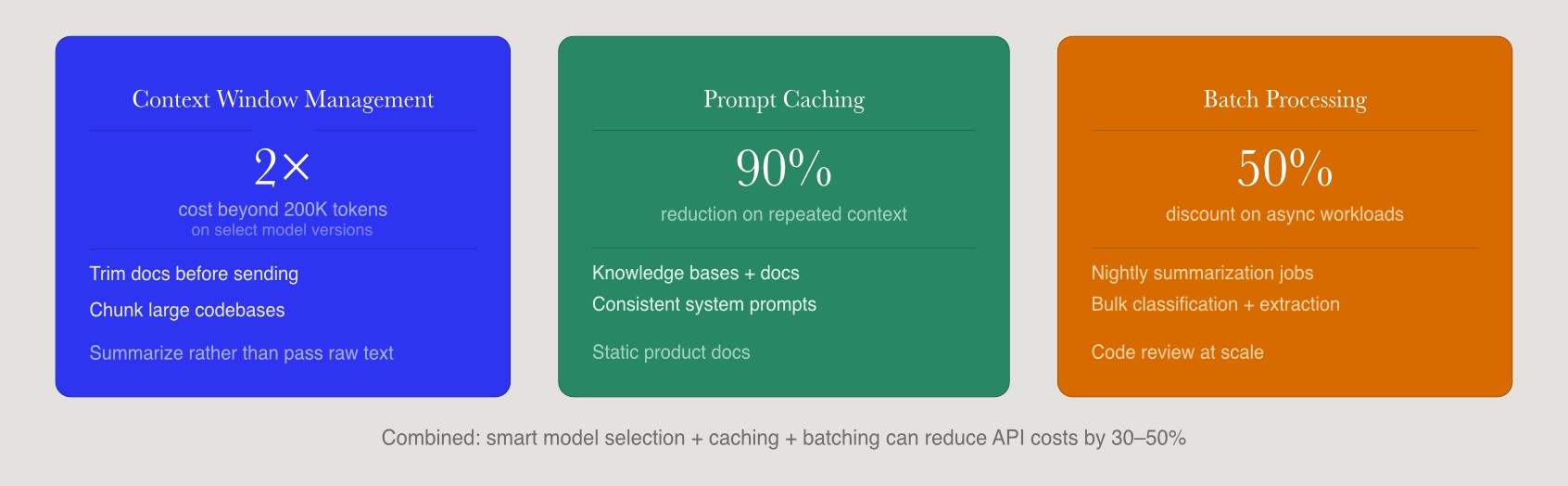
Most Claude cost surprises come from three things: exploding context windows, verbose outputs, and not using available discounts. Here’s how to manage each.
Context Window Management
Sonnet 4.5’s context window pricing works in tiers. The first 200K tokens bill at base rates. Beyond that threshold, up to 1M tokens, you pay roughly double.
Best practices:
Trim documents before sending to Claude
Chunk large codebases into focused sections
Summarize lengthy context rather than passing raw text
Prompt Caching
When you leverage prompt caching, static system prompts or long documents are cached once at full price. Subsequent API calls using the same cached content are billed at roughly 10% of the normal input cost.
This is powerful for:
Knowledge bases and documentation-heavy workloads
Consistent system prompts across many conversations
Product docs that don’t change frequently
A 90% discount on repeated context can radically reduce spend for enterprise search applications and internal tools.
Batch Processing
For low-urgency tasks like nightly summarization jobs, bulk classification, or async analysis, the batch API offers approximately 50% discount on token costs.
Batch-friendly workloads include:
Content moderation queues
Email summarization
Data extraction from documents
Code review at scale
General Best Practices for Cost Management
Keep prompts and outputs tight; verbosity costs money
Default to Haiku or Sonnet; reserve Opus 4.5 for the hardest problems
Monitor token usage per feature, especially for SaaS products embedding Claude
Estimate costs before scaling by running token counts on sample workloads
Consider the usage object data from API responses to track actual consumption
Where Fonzi AI Fits: Turning Claude Spend into Real Product Velocity
While Claude pricing plans determine your marginal AI cost, hiring the right people determines whether that spend turns into shipped features, customer value, and actual ROI.
Fonzi AI is a curated talent marketplace focused on elite AI, ML, and software engineers, matching them with AI startups and high-growth tech companies. Rather than months-long recruiting cycles, Fonzi runs a structured hiring event called Match Day.
How Match Day works:
Pre-vetted engineers with verified AI/ML skills enter a timeboxed hiring window
Companies commit to salary ranges upfront for transparency
Vetted candidates and hiring teams are matched based on skills and fit
Most offers and hires close inside a 48-hour window
Typical time from first contact to accepted offer: about 3 weeks
Fonzi supports both early-stage startups hiring their first AI engineer to build on Claude and large enterprises staffing multiple Claude-powered initiative pods. The same structured, scalable process works from your first AI hire to your 10,000th.
Key differentiators for Claude-heavy teams:
Bias-audited technical evaluations
Fraud detection for candidate verification
Concierge recruiter support throughout the process
Upfront salary transparency with no wasted time on mismatched expectations
Pre-vetted AI/ML skill sets aligned to modern LLM stacks
The candidate experience is preserved and elevated through the process, ensuring you’re meeting engaged, well-matched talent rather than candidates who’ve been through a recruiting grinder.
Conclusion
Claude’s 2026 pricing spans everything from a free tier for light experimentation to Pro and Max plans for individuals, Team and Enterprise options for organizations, and usage-based API pricing for models like Opus 4.5, Sonnet 4.5, and Claude Haiku in production. Choosing the right mix of subscriptions, team seats, and API usage can save companies thousands each year, but the biggest gains come from engineers who know how to design cost-efficient Claude workflows, including when to use Haiku versus Sonnet and how to optimize spend with prompt caching and batch processing.
If you’re planning to go deeper with Claude, having the right AI engineering talent is what turns pricing decisions into real business value. Fonzi AI helps companies connect with pre-vetted AI and ML engineers who already know how to build and scale Claude-powered systems. Join the next Fonzi AI Match Day to meet qualified candidates quickly and hire in weeks instead of months, whether you’re making your first AI hire or scaling a full team.
FAQ
What is the current price of Claude Pro and what are the main benefits over the free version?
How do the new Claude Max 5x and 20x pricing tiers differ in terms of message limits and features?
What is the cost per person for the Claude Team plan and does it require a minimum number of users?
Is there a discount for Claude Pro or Team plans if I choose to be billed annually instead of monthly?
How does Fonzi AI help teams get more value out of their Claude spend?