By 2026, we’re generating more than 330 million terabytes of data every single day. At that scale, human-only analytics just can’t keep up. Over the last few years, we’ve moved well beyond basic chatbots that answer data questions. Modern analytics tools now act as true analytics copilots, built directly into BI platforms and data warehouses. Like the evolution from code autocomplete to autonomous coding agents, these systems don’t wait for instructions; they continuously monitor metrics, spot patterns, and surface insights on their own.
That shift fundamentally changes how teams work with data. Traditional BI tools like Tableau or Power BI relied on analysts to manually write queries and build dashboards. AI-native analytics workflows, on the other hand, support natural language querying, automated hypothesis testing, and real-time anomaly detection. For startups and AI-driven businesses, this unlocks powerful use cases, such as live LTV/CAC tracking, automated cohort analysis, infrastructure cost optimization, statistically sound product experiments, and precise sales funnel diagnostics. Building and maintaining these systems requires highly specialized AI and data engineers, which is where Fonzi AI comes in. Fonzi AI helps companies quickly hire the engineers who design, own, and scale these AI analytics platforms so your data strategy can move as fast as your business does.
Key Takeaways
Modern AI tools like Microsoft Fabric, BigQuery, Snowflake, and emerging analytics agents can now automate 60–80% of routine data analysis tasks, including cleaning, joins, anomaly detection, and forecasts.
Founders and CTOs should treat AI for data analysis as a core part of their stack, not an experiment. Companies using these systems report concrete ROI through revenue optimization, churn reduction, and fraud detection.
This article compares the best AI data analysis tools for 2026, shows how to use them without heavy coding, and explains key statistics every leader should track.
While tools lower the barrier for self-service analytics, you still need strong AI/data engineers to design schemas, govern access, and productionize machine learning models.
Fonzi AI offers the fastest way to hire elite AI engineers who can actually implement and scale these AI analytics systems, and most hires happen within 3 weeks through our Match Day events.
What Is AI Data Analysis Today?
AI data analysis in 2026 means using machine learning, large language models, and autonomous agents to collect, clean, explore, model, and explain data with minimal manual coding. It’s the convergence of data science, automation, and natural language interfaces into a single, accessible capability.
Here’s how AI supports each stage of the analysis lifecycle:
Ingestion: Automated connectors pull from multiple datasets and data sources simultaneously, handling schema detection and format conversion
Cleaning: AI identifies missing values, outliers, and inconsistencies through data preparation pipelines that previously required hours of manual work
Feature Engineering: Machine learning algorithms suggest relevant features based on correlation analysis and importance scores
Statistical Modeling: From regression to clustering to hypothesis testing, AI handles complex statistical analysis that once required deep technical expertise
Visualization: Systems automatically visualize data in the most appropriate chart types and highlight what matters
Storytelling: LLMs generate plain-English explanations of findings, making actionable insights accessible to non-technical users
The types of AI models commonly used include:
Gradient-boosted trees (XGBoost, LightGBM) for tabular business data
Deep learning models for text, image, and video analysis
Time-series models for forecasting revenue, demand, and other temporal patterns
LLMs as “orchestrators” that coordinate queries, interpret results, and communicate findings
There’s an important distinction between “assistive AI” and “autonomous AI.” Assistive AI suggests queries and writes SQL when you ask. Autonomous AI continuously monitors metrics, raises alerts, and runs root-cause experiments without prompts. Both have their place, but the trend is clearly toward autonomous systems that analyze data proactively.
One critical note: while AI can generate SQL, Python, and complex reports, human oversight remains essential for setting business goals, validating assumptions, and preventing spurious correlations. The best predictive models are useless if they’re answering the wrong questions.
How to Use AI for Data Analysis (Even Without Python or R)
In 2026, non-technical leaders can run serious analyses through natural language interfaces in tools like Power BI Copilot, BigQuery Data Canvas, and custom AI agents. You don’t need coding knowledge to extract valuable information from complex datasets.
Here’s a high-level workflow a founder or PM could follow:
Connect data sources: Link your CRM, product analytics, billing system, and other platforms to your analytics platform
Describe your question in natural language: “Show me which customer segments have the highest churn rate in Q1 2026.”
Iterate with the AI: Refine filters, adjust cohorts, and drill into specific segments through conversational prompts
Export and share: Generate charts, summaries, and presentations for stakeholders
Practical workflows you can run today without Python or R:
Churn prediction: Upload cohort data from 2023–2025, ask the system to identify patterns among churned customers, and generate predictive insights for at-risk accounts
Marketing attribution: Feed in multi-channel campaign logs and let the AI determine which touchpoints drive conversions
Pricing sensitivity: Analyze transactional history data to understand how price changes affect purchase behavior across segments
Customer feedback analysis: Use sentiment analysis on support tickets and reviews to identify product issues
A concrete example of a natural language query: “Compare 2024 Q4 conversion rates by channel in North America vs Europe and explain key differences in plain English.” The AI handles the SQL, runs the comparison, and delivers real-time insights in language any business user can understand.
Teams with AI engineers from Fonzi AI can go beyond “chat with data” and build specialized internal agents. Imagine a “Revenue Analyst Bot” that monitors ARR daily and alerts leadership when growth decelerates, or a “Fraud Monitor Bot” integrated into Slack that flags suspicious transactions in real-time.
Best AI Data Analysis Tools in 2026
This section provides a practical overview of leading tools that founders and data leaders actually deploy, not an exhaustive directory. The goal is to help you shortlist options based on your company stage, technical depth, and specific needs.
We’ll start with a comparison table, then provide short profiles of each tool, focusing on concrete capabilities, ideal company size, and pricing tier signals.
Comparison Table: AI Data Analysis Tools & When to Use Them
Tool | Best For | Technical Skill Needed | Key AI Features | Typical Company Stage | Notable Limitations |
Microsoft Power BI + Copilot | Internal dashboards at companies already on Microsoft 365 | Low-Medium | NL-to-SQL, auto-generated explanations, Azure ML integration | Series A to Enterprise | Vendor lock-in with Microsoft ecosystem |
Google BigQuery Studio + Looker | Data-heavy companies needing warehouse-native analytics | Medium | Gemini-based NL queries, auto-visualization, SQL + chat | Series B to Enterprise | Steeper learning curve for Looker configuration |
Snowflake Cortex | Companies already using Snowflake for data warehousing | Medium | In-warehouse ML, LLM-powered search, predictive functions | Series B to Enterprise | Requires Snowflake commitment |
Tableau + Tableau GPT | Visual-first analytics teams needing polished dashboards | Low-Medium | Tableau Pulse, NL queries, automated insights | Series A to Enterprise | Can get expensive at scale |
Hex | Data teams wanting notebooks + collaboration + AI assist | Medium-High | AI-assisted code, shareable apps, version control | Seed to Series B | Requires some Python/SQL knowledge |
Akkio | No-code predictive analytics for non-technical teams | Low | Drag and drop functionality, auto-ML, forecasting | Seed to Series A | Limited customization for advanced users |
Python + Notebook + Copilot | Engineer-led teams needing maximum flexibility | High | Full AI copilot assistance, any library available | Any stage | Requires strong technical expertise |
Key interpretations:
Seed-stage startups: Start with Akkio or Hex for speed. You can migrate later as you scale.
Mid-market SaaS (Series A-B): Power BI or Tableau offer the best balance of capability and user friendly interface.
Global enterprises with strict governance: BigQuery or Snowflake provide the security controls and audit capabilities you need.
Profiles of Top AI Analytics Platforms
Microsoft Power BI with Copilot
Power BI enables users to create dashboards and reports with a user-friendly interface that non-technical users can navigate. The 2025-2026 Copilot integration transformed it into a true AI data analyst, which you can ask questions in natural language and get visualizations instantly.
Main strengths: Deep Microsoft 365 integration, NL-to-visual generation, Azure ML connectivity
Ideal for: Companies already invested in Microsoft stack, teams needing self-service analytics
Learning curve: Gentle for basic use; steeper for advanced DAX and data modeling
Standout AI features: Copilot chat, auto-generated narrative explanations, anomaly detection alerts
Google BigQuery Studio & Looker with Gemini
BigQuery Studio combines the power of Google’s data warehouse with Gemini-based AI for conversational analytics. Looker adds a semantic layer that enables users to create consistent metrics across the organization.
Main strengths: Warehouse-native AI, excellent for large-scale data processing, strong data integration capabilities
Ideal for: Data-heavy companies, ML teams needing tight integration between analytics and model training
Learning curve: Moderate; LookML requires some ramp-up time
Standout AI features: Natural language SQL generation, auto-visualization, exploration suggestions
Tableau with Tableau GPT and Pulse
Tableau remains the gold standard for data visualization, and Tableau GPT brings conversational AI to its intuitive interface. Tableau Pulse delivers automated monitoring of business metrics.
Main strengths: Best-in-class visualizations, strong community and templates, Einstein integration
Ideal for: Teams prioritizing visual storytelling and executive dashboards
Learning curve: Low for consumers; moderate for dashboard creators
Standout AI features: Pulse automated insights, GPT-powered Q&A, smart recommendations
Snowflake Cortex
Snowflake Cortex brings AI directly into the data cloud, letting you run machine learning models and LLM queries without moving data out of your warehouse. It’s built for teams already using Snowflake who want advanced analytics capabilities without additional infrastructure.
Main strengths: In-warehouse ML, unified governance, strong security controls
Ideal for: Enterprises with Snowflake as their primary data platform
Learning curve: Moderate; best if the team knows SQL
Standout AI features: Document AI, ML functions, LLM-powered search
Hex and Akkio for Emerging Use Cases
Hex bridges the gap between notebooks and BI tools, ideal for data science teams that want collaboration features without sacrificing flexibility. Akkio takes a different approach: pure no-code predictive analytics for business users who want instant insights from raw data.
One important note on all these tools: vendor lock-in is a real risk. The more you embed a platform’s proprietary features into your data workflows, the harder it becomes to switch. This is why having strong in-house AI engineering expertise matters; your team can build abstraction layers and avoid depending entirely on black-box tools.
From Dashboards to Autonomous Analytics Agents
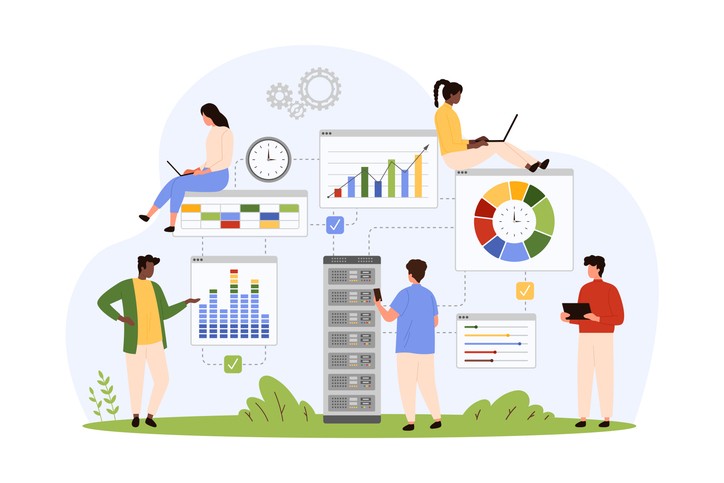
The evolution is stark. From 2015-2020, we had static dashboards that showed what happened last quarter. From 2021-2023, real-time monitored metrics with automatic alerts told us when something went wrong. Now, in 2024-2026, fully autonomous agents don’t just alert, they investigate, explain, and propose experiments.
An “analytics agent” in practice is an LLM-based system with access to your data warehouse, metric definitions, and workflow tools like Jira and Slack. When revenue drops, the agent doesn’t just ping you; it segments by region, cohort, and product line to identify patterns, then recommends specific actions based on historical data.
Concrete agent capabilities in 2026 include:
Continuous KPI monitoring: Watching hundreds of metrics simultaneously, 24/7
Automated incident triage: “Revenue dropped 12% in EMEA and here’s why, based on my analysis of the last 30 days”
Root-cause analysis by segment: Breaking down anomalies by customer type, geography, product, or channel
Automated weekly summaries: Leadership receives synthesized performance reports with meaningful insights highlighted
Proactive experiment suggestions: “Based on customer behavior patterns, testing a 15% discount for churning enterprise accounts could recover $40K MRR”
Consider a “Product Growth Agent” that tracks activation rates across iOS and Android. When iOS activation drops 8% over two weeks, the agent flags the regression, identifies that it correlates with a specific app version, and suggests an A/B test with estimated impact based on historical data from similar issues.
Building safe, reliable analytics agents requires a cross-functional team: AI engineers to architect the LLM pipelines, data engineers to ensure clean data flows, and analytics leads to define what “good” looks like. This is exactly the profile that Fonzi AI specializes in: helping companies hire these roles quickly through our Match Day events.
Statistics & Metrics Every AI-Driven Company Should Track
Tools don’t matter if teams aren’t tracking the right metrics. Here’s what to monitor in 2026 for AI-native and SaaS businesses.
Growth & Revenue Metrics
MRR and ARR with cohort breakdowns
LTV/CAC ratio by acquisition channel
Net revenue retention (NRR)
Expansion and contraction of revenue
Product & Engagement Metrics
DAU/MAU ratio as a health indicator
Activation rate within the first 7 days
Feature adoption rates for new releases
Time-to-value for new customers
Operations Metrics
Infrastructure cost per active user
GPU utilization for ML workloads
Query latency and error rates in data pipelines
Data freshness and pipeline reliability
AI Quality Metrics
Model accuracy and drift over time
Hallucination rate for LLM-powered features
User satisfaction scores for AI-generated outputs
False positive rates in predictive models
AI tools can automatically compute, visualize data, and forecast these metrics. For example, using historical data from 2022-2025, an AI tool might project 2026-2027 ARR growth bands and identify risk scenarios: “If churn increases 2% and expansion revenue stays flat, you’ll miss your 2027 target by $2M.”
A critical caveat: AI can’t fully prevent common statistical pitfalls like survivorship bias, overfitting, and misinterpreted correlations. Human review remains essential for data-driven decisions. The best analytics teams use AI to generate hypotheses faster, then apply human judgment to validate them.
Security, Governance, and Compliance in AI Analytics

By 2026, most serious AI analytics deployments must address security, privacy (GDPR, CCPA), and SOC 2 / ISO 27001-level controls. This isn’t optional for companies handling sensitive business data.
How AI tools handle sensitive datasets:
Role-based access control: Different permissions for executives, analysts, and external partners
Column-level masking: Hide salary, financial, and PII fields from users who don’t need them
Encryption at rest and in transit: Industry-standard protection for data in your data warehouse
Audit logs for AI-generated queries: Track exactly what questions the AI answered and what data it accessed
When evaluating enterprise readiness, check for:
Data residency options (can you keep data in specific regions?)
Private model hosting (does the vendor train on your own data?)
Ability to disable training on proprietary data
SSO/SCIM integration for user management
SOC 2 Type II certification and regular security audits
AI engineers typically implement governance through semantic layers that define approved metrics, controlled prompt templates that limit what users can query, and guardrails that prevent exfiltration of secrets in generated code. The data stays private when these controls are properly configured.
Companies hiring through Fonzi AI can specifically target engineers experienced with secure data stacks in fintech or healthcare, avoiding compliance regressions as AI analytics usage expands across the organization.
Building Your AI Data Analysis Stack: Roles, Skills, and Hiring
Tools change fast, but the core roles needed to design, build, and scale AI analytics systems are more stable. Understanding these roles helps you build the right team.
Critical roles for an AI analytics stack:
Role | Primary Responsibility | Key Skills |
AI/ML Engineers | Build and deploy machine learning models | Python, PyTorch/TensorFlow, MLOps, LLM orchestration |
Data Engineers | Design and maintain data pipelines | SQL, Spark, Airflow, dbt, cloud platforms |
Analytics Engineers | Create semantic layers and business metrics | dbt, SQL, BI tools, business context |
Data Scientists | Develop predictive models and run experiments | Python, statistics, ML, experimentation frameworks |
Analytics Leaders | Translate business questions to measurable metrics | Communication, business strategy, tool selection |
Concrete technical skills to look for:
Python and SQL proficiency for data engineering and analysis
Experience with dbt for transformation and semantic layers
Airflow or similar tools for workflow orchestration
Spark for large-scale data processing
LLM orchestration frameworks (LangChain, etc.)
BI configuration for Tableau, Power BI, or Looker
Cloud experience with AWS, Azure, or GCP
For early-stage startups at seed or Series A, you might combine roles. One strong AI generalist can own both modeling and pipelines. As you scale to Series B and beyond, you’ll need more specialization, such as dedicated data engineers, ML engineers, and analytics engineers working as a coordinated team.
Fonzi AI is a curated talent marketplace where startups and enterprises can hire pre-vetted AI, data, and full-stack engineers with experience in building production analytics and GenAI systems. We focus specifically on the technical depth needed for real implementation, not just superficial familiarity with tools.
How Fonzi AI’s Match Day Helps You Hire AI Analytics Talent Fast
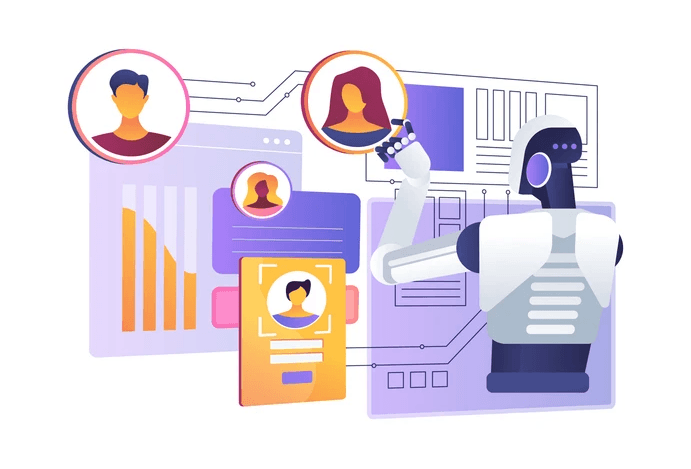
Fonzi AI’s Match Day works differently from traditional recruiting:
Companies submit role details and salary ranges upfront, creating transparency from day one
Fonzi pre-matches companies with vetted engineers whose skills align with the specific requirements
Both sides join a focused 48-hour hiring event where interviews happen rapidly, and decisions get made
Most hires close within 3 weeks from initial engagement to signed offer
We vet candidates for hands-on skills in data analysis tooling, ML/AI, and software engineering. This reduces the risk of hiring someone who only has superficial prompt-engineering knowledge but can’t actually build production systems.
Key benefits of hiring through Fonzi:
Salary transparency eliminates negotiation friction
Bias-audited evaluation steps ensure fair candidate assessment
Concierge recruiter support handles scheduling and feedback logistics
You can hire from your first AI engineer to your 10,000th through the same process
Consider a hypothetical Series B startup building an AI analytics agent for e-commerce. Through Fonzi, they hired two AI engineers on a single Match Day. Within 60 days, the team shipped an MVP that reduced manual data exploration by 70% and identified $200K in recoverable revenue through automated churn prediction.
Conclusion
AI has completely changed data analysis from a slow, quarterly reporting task into a continuous, semi-automated capability. The companies pulling ahead in 2026 understand that great tools alone aren’t enough; success comes from pairing powerful AI platforms with equally strong teams. While non-technical users can now ask questions in plain English, it still takes experienced engineers to design the data models, enforce governance, build custom agents, and make sure insights are accurate, secure, and actually useful.
That’s where Fonzi AI fits in. Fonzi AI helps startups and enterprises hire top-tier AI and data engineers quickly and reliably, whether you’re standing up your first analytics pipeline or scaling a complex agent-driven system. With Fonzi AI Match Days, you can meet vetted AI analytics talent in days and turn your analytics stack into a real growth driver instead of a tool that sits idle.
FAQ
What are the best AI tools for automated data analysis and visualization in 2026?
How can I use AI to perform complex statistical analysis without knowing Python or R?
Is AI for data analysis secure enough to handle sensitive company financial information?
What is the difference between a traditional BI tool and an AI-driven analytics agent?
Can AI tools automatically detect anomalies and trends in my data without manual prompts?